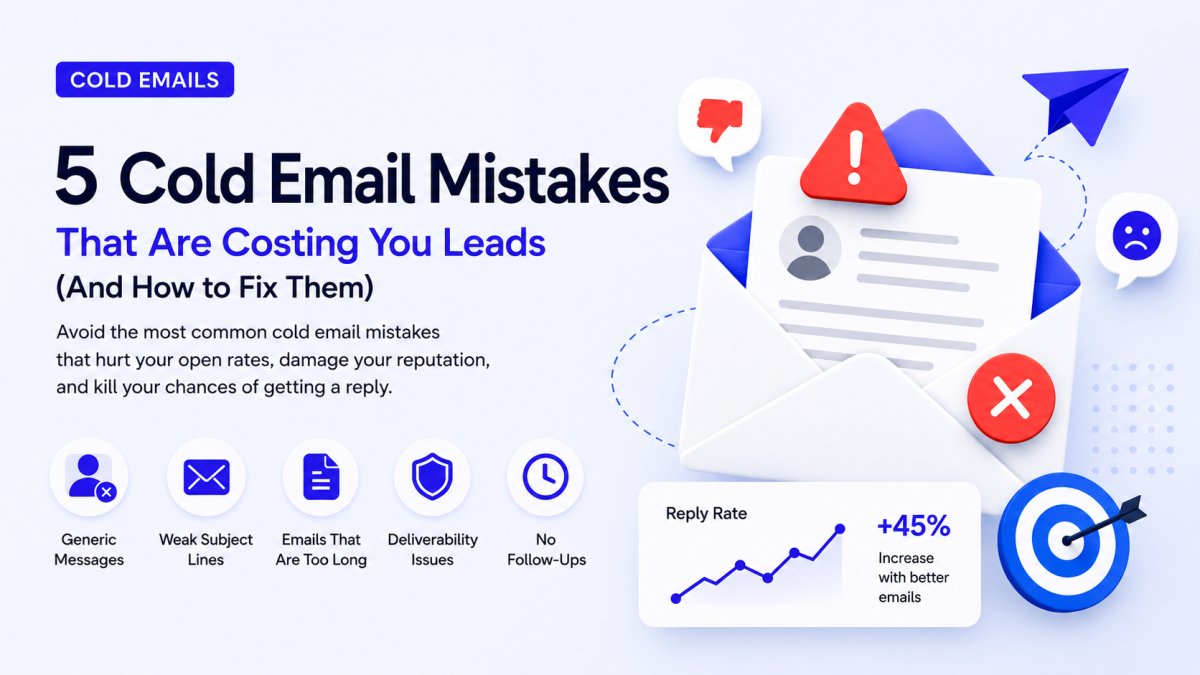
Cold email remains one of the most effective ways to generate leads, start conversations, and grow a business. Yet many companies spend hours building prospect lists and writing outreach campaigns only to receive little or no response.
The problem is often not the offer itself. It's the way the email is written and delivered.
In this guide, we'll cover the most common cold email mistakes, why they hurt your results, and how to fix them to improve your open rates, reply rates, and conversions.
Why Cold Email Campaigns Fail
Many businesses assume that sending more emails will generate more leads. In reality, poor targeting and weak messaging can damage your sender reputation and reduce your chances of reaching potential customers.
Cold email success depends on three things:
Reaching the right people
Delivering a relevant message
Following up consistently
Before increasing volume, make sure you're avoiding the mistakes below.
1. Sending Generic Messages
One of the biggest cold email mistakes is sending the exact same message to every prospect.
Modern buyers receive dozens of emails every day. If your email feels automated or irrelevant, it will likely be ignored.
Bad Example
"Hello, I hope you're doing well. We offer innovative solutions that can help your business grow."
Better Example
"Hi Sarah, I noticed your company recently expanded into the European market. We help businesses automate customer support during rapid growth phases."
Personalization shows that you've done your research and significantly increases engagement.
Even simple details like mentioning a prospect's industry, company growth, recent announcement, or business challenge can make a huge difference.
2. Writing Weak Subject Lines
Your subject line determines whether the email gets opened at all.
Many sales teams use generic subject lines such as:
Quick Question
Following Up
Business Opportunity
These provide little value and fail to create curiosity.
Better Subject Lines
Idea to Improve Your Lead Response Time
Question About Your Customer Support Process
Reducing Missed Leads on Your Website
Quick Suggestion for Your Sales Team
Thought About Your Customer Experience
Keep subject lines short, relevant, and focused on the recipient.
A great email won't help if nobody opens it.
3. Making the Email Too Long
A cold email is not a sales presentation.
Long paragraphs, excessive company information, and multiple offers create friction.
Most successful cold emails are between 50 and 150 words.
Simple Structure
Personalized opening
Relevant problem
Short solution
Single call-to-action
The goal is not to close the sale.
The goal is to start a conversation.
Prospects don't need your entire company history. They need a reason to reply.
4. Ignoring Deliverability and Spam Filters
Even a well-written email won't generate results if it lands in the spam folder.
Common deliverability issues include:
Missing SPF records
Missing DKIM authentication
Too many links
Spam-trigger words
Sending high volumes from new domains
Before launching campaigns, ensure your email domain is properly configured and warmed up.
Common Spam Trigger Words
Guaranteed
100% Free
Act Now
Risk-Free
Limited Time Offer
Avoid excessive capitalization, misleading claims, and overly promotional language.
Why Cold Emails Go to Spam
Many businesses focus heavily on writing better emails but ignore technical setup.
Even great outreach campaigns can fail if your emails never reach the inbox.
Common reasons cold emails go to spam include:
Poor sender reputation
Missing email authentication records
High bounce rates
Sending too many emails too quickly
Low engagement from recipients
Excessive links and images
Email deliverability should be monitored just as carefully as open and reply rates.
A small technical issue can reduce campaign performance dramatically.
Combining email outreach with website lead capture tools can significantly improve conversion rates.
5. Never Following Up
Many sales representatives send one email and move on.
This is a costly mistake.
Most prospects are busy. They may have seen your email but simply forgot to respond.
Studies consistently show that many replies come after multiple follow-ups.
A simple follow-up sequence may look like:
Day 1: Initial outreach
Day 4: First follow-up
Day 8: Second follow-up
Day 14: Final message
Keep follow-ups short and focused on providing value.
Avoid sending messages that simply say "Just checking in."
Instead, add new information, a useful resource, or a different angle.
Cold Email Mistakes Summary
Generic Messaging
Impact: Low response rates
Fix: Personalize every email.
Weak Subject Lines
Impact: Low open rates.
Fix: Focus on relevance and curiosity.
Long Emails
Impact: Lower engagement.
Fix: Keep emails concise and actionable.
Poor Deliverability
Impact: Emails land in spam.
Fix: Configure SPF, DKIM, and warm up your domain.
No Follow-Ups
Impact: Lost opportunities.
Fix: Create a consistent follow-up sequence.
Cold Email Best Practices
Personalize every email whenever possible
Keep messages concise
Use a clear call-to-action
Verify contact information before sending
Track opens and replies
Follow up consistently
Test different subject lines
Monitor sender reputation
Remove inactive contacts from campaigns
Continuously improve based on results
Successful cold email campaigns are built through testing, optimization, and consistency.
Frequently Asked Questions
How many cold emails should I send per day?
For new domains, start with 20 to 30 emails per day and gradually increase volume as your reputation improves.
Why do cold emails go to spam?
Common causes include poor sender reputation, missing SPF or DKIM records, spam-trigger words, high bounce rates, and low engagement.
How many follow-ups should I send?
Most campaigns perform best with 3 to 5 follow-ups spread over several weeks.
Are cold emails still effective?
Yes. When properly targeted and personalized, cold email remains one of the most cost-effective lead generation strategies available.
How long should a cold email be?
Most successful cold emails are between 50 and 150 words and focus on starting a conversation rather than making a complete sales pitch.
Final Thoughts
Businesses looking to improve lead generation and customer engagement can also explore AI-powered automation tools designed to capture and qualify leads automatically.
Avoiding these common cold email mistakes can dramatically improve your outreach performance.
Success doesn't come from sending more emails. It comes from sending better emails to the right people with the right message.
Personalization, strong subject lines, proper deliverability practices, and consistent follow-up can significantly increase your chances of turning cold prospects into valuable business opportunities.
Small improvements in your process can lead to major improvements in open rates, reply rates, and ultimately revenue.
The businesses that consistently generate leads through cold email aren't necessarily sending more messages. They're sending smarter ones.
```