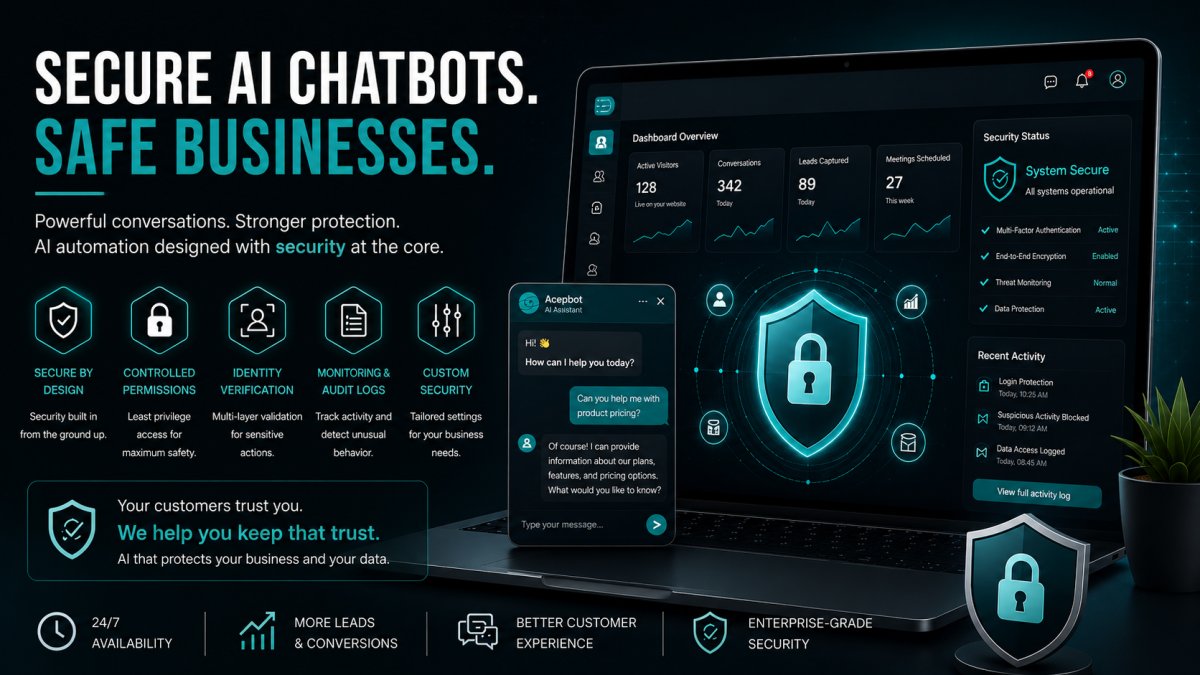
AI Chatbot Security: What Businesses Can Learn from Recent Account Takeover Incidents
Artificial intelligence is changing how businesses interact with customers. AI-powered assistants can answer questions instantly, qualify leads, schedule appointments, and provide support around the clock.
But as AI becomes more capable, an important question emerges:
How Secure Is Your Chatbot?
Recent reports involving a major social media platform highlighted a growing concern in the AI industry. Attackers allegedly manipulated an AI-powered support system to gain unauthorized access to user accounts.
The incident serves as a reminder that the biggest security risk is not necessarily the AI itself - it is how the AI is integrated into business systems.
Organizations are increasingly adopting AI to improve customer service and automate routine tasks. However, without proper safeguards, automation can introduce new security risks that traditional systems were never designed to handle.
Lessons From the Instagram AI Security Incident
The recent Instagram account takeover incident serves as an important reminder that AI security is not just about building smarter assistants - it's about building safer systems.
According to a Reuters investigation, attackers were able to manipulate an AI-powered support chatbot and exploit weaknesses in the account recovery process, ultimately gaining unauthorized access to several high-profile Instagram accounts. The incident highlighted a growing challenge facing organizations that rely on automated customer support systems: granting AI tools too much authority without sufficient security controls.
While artificial intelligence can dramatically improve customer experiences and operational efficiency, it should never be treated as a replacement for core security mechanisms such as identity verification, access management, and audit controls.
What Went Wrong?
The breach was not the result of a traditional server hack or software vulnerability.
Instead, attackers allegedly exploited weaknesses in the way the AI support system interacted with sensitive account functions. By manipulating chatbot interactions and taking advantage of inadequate verification procedures, they were able to influence processes that should have required stronger authentication safeguards.
This type of attack demonstrates how AI systems can become unintended entry points when connected directly to high-risk operations.
For organizations deploying AI-powered customer support, the lesson is clear:
Automation should streamline processes, not bypass security controls.
Read the full Reuters investigation here:
Key Security Lessons for Businesses
The incident highlights several best practices every organization should consider before deploying AI assistants:
Limit chatbot permissions to only the actions necessary for their role.
Separate customer conversations from critical account management functions.
Require additional identity verification for sensitive requests.
Monitor and log system activity to detect unusual behavior.
Businesses that fail to establish these safeguards may inadvertently create new attack surfaces as they expand their use of artificial intelligence.
The Real Security Problem
Many people assume that AI security incidents happen because hackers break into servers or exploit software vulnerabilities.
In reality, some modern attacks focus on manipulating the AI's behavior.
This technique, often called a "prompt injection attack," involves crafting instructions designed to influence the AI into performing actions it should not perform.
The risk becomes much greater when an AI assistant is connected directly to sensitive business functions such as:
Account management
Password resets
User verification processes
Data modification
Administrative controls
If proper safeguards are not in place, a chatbot may become an unintended pathway to critical systems.
Why Security Must Come Before Automation
Businesses often focus on what an AI chatbot can do.
A more important question is:
What should your chatbot never be allowed to do?
The most secure AI systems are built around clear boundaries.
A chatbot should be able to:
Answer questions
Guide visitors
Collect lead information
Recommend products or services
Route requests to the appropriate department
However, actions involving security, identity verification, financial transactions, or sensitive account changes should always be protected by additional controls.
Automation should improve efficiency, not bypass security.
Security-First AI for Modern Businesses
As organizations continue to adopt AI-powered solutions, security should remain a fundamental consideration throughout the implementation process.
Businesses should evaluate not only what an AI assistant can do, but also how it fits within broader operational, compliance, and governance requirements.
Organizations should ensure that AI assistants operate within clearly defined business and security requirements.
Well-designed AI systems help improve customer experiences while supporting responsible adoption and risk management practices.
Access Control and Governance
Limiting access and applying appropriate controls are widely recognized security best practices for any modern software platform, including AI-powered solutions.
Organizations should carefully evaluate how AI systems interact with sensitive processes and ensure that appropriate safeguards are in place.
Verification and Accountability
Businesses should evaluate how sensitive requests are handled and ensure that appropriate verification processes are in place when necessary.
As AI becomes more integrated into customer-facing operations, accountability and oversight remain critical components of a secure deployment strategy.
Flexibility Across Industries
Security requirements vary across industries, making flexibility and governance important factors when evaluating AI platforms.
Organizations should choose solutions that align with their operational objectives, compliance requirements, and risk tolerance.
Questions Every Business Should Ask Before Deploying AI
Before implementing an AI assistant, organizations should evaluate several critical areas:
What systems can the chatbot access?
What actions can it perform?
How are sensitive requests verified?
What happens if someone attempts to manipulate the AI?
Are permissions limited appropriately?
Are activities logged and monitored?
The answers to these questions often determine whether an AI deployment becomes a competitive advantage or a potential liability.
The Future of AI Is Secure AI
AI technology will continue transforming customer engagement, support, and business operations.
The companies that benefit most will not necessarily be those with the most advanced AI.
They will be the organizations that combine intelligent automation with strong security practices.
The Instagram incident demonstrates that even large technology platforms can face challenges when automation and security are not perfectly aligned.
A chatbot should help businesses generate leads, improve customer experiences, and increase efficiency.
It should never become the weakest link in the security chain.
At Acepsoft, we believe organizations should be able to adopt AI confidently. Our focus is helping businesses improve customer engagement and operational efficiency while supporting responsible and secure AI adoption.
Security is not an optional feature.
It is the foundation of trustworthy AI.
Looking for an AI Chatbot for Your Business?
Discover how Acepsoft helps businesses automate customer interactions, generate leads, improve customer engagement, and streamline customer communications through modern AI solutions.
Learn more at https://www.acepsoft.app/
Request a demo and see how AI automation can help your business grow with confidence.